How do the best agencies price a project?
Most agencies don't use one pricing model. They use three or four at once. A markup on venue and AV, a fee for the producer's time, commission from a hotel, and a day rate for the extra workshop the client added in week six.
That works until it all lives in one spreadsheet and nobody can say what the margin on the project really is.
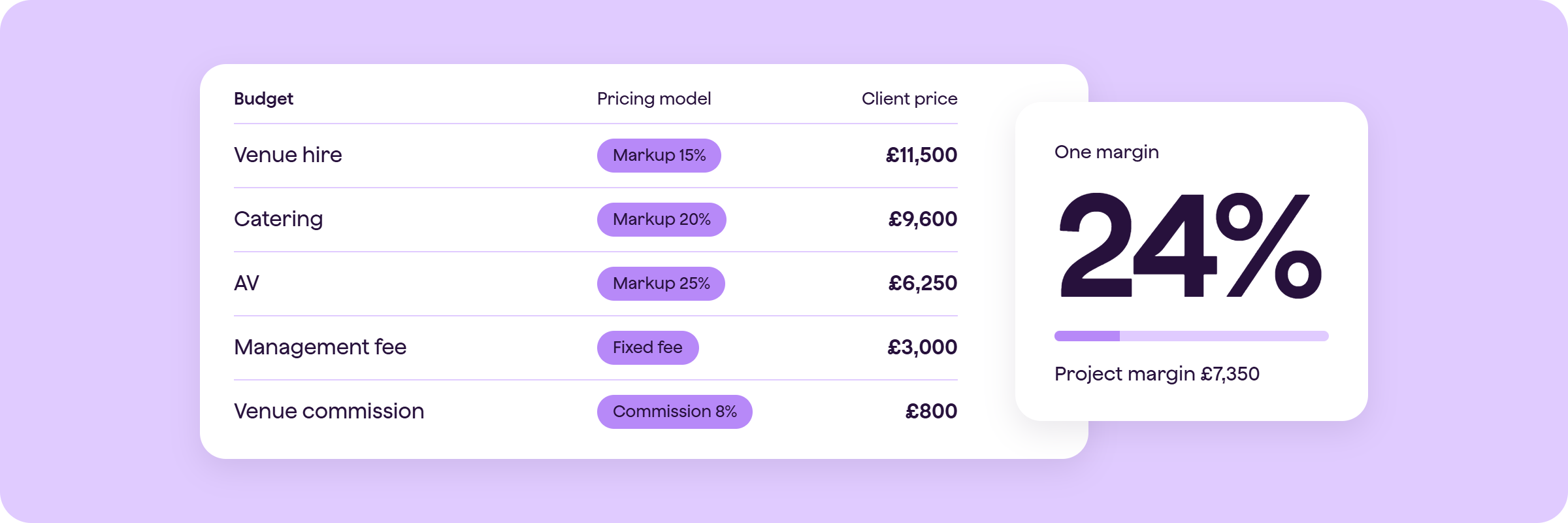
How do events agencies actually make money on a project?
There are four common models:
-
Markup. You add a percentage to the supplier cost. A £10,000 venue with a 15% markup is sold to the client at £11,500.
-
Management fee. A charge for running the project, either a fixed amount or a percentage of the total budget. The client sees it as its own line.
-
Time and materials. You bill the hours your team spends at agreed day or hourly rates, plus supplier costs at cost or with a small markup.
-
Commission. A supplier, such as a hotel or venue, pays you a percentage of the booking value. The client price does not change.
Most agencies mix them. A typical conference might carry a markup on AV and catering, a fixed management fee, and commission on the venue.
Each model hides margin in a different place. That's why a budget that mixes them gets fragile fast, and why it helps to see all of them in one view.
What's the difference between markup and margin?
Markup is calculated on cost. Margin is calculated on the sell price. The same deal gives you two different percentages.
Take a £1,000 cost with a 25% markup. The sell price is £1,250 and you earn £250. That £250 is 25% of the cost but 20% of the sell price, so the margin is 20%.
This matters because the two get mixed up all the time. If your finance lead talks about margin and your producer talks about markup, you are discussing different numbers, and the project quietly gets underpriced.
A quick guide: a 20% margin needs a 25% markup. A 30% margin needs a markup of about 43%. Pick one measure for your budgets and label it clearly.
When does a markup make sense, and when is a management fee better?
A markup works best for costs that grow with the event.
Venue, catering, AV and transport are the usual ones. Your margin rises with the spend, the client sees one price per line, and it's easy to explain.
Watch out for two things. Markups that vary line by line can look inconsistent if a client compares quotes. And a markup does not pay you for effort on small-ticket work. Ten hours of sourcing for a £500 item earns almost nothing.
A management fee works best when your effort doesn't scale with spend.
Strategy, creative direction, project management and the on-site team all fall here. A fixed fee gives the client certainty. A percentage of the budget grows with the project but can feel arbitrary to the client.
The risk with a fixed fee is scope. If the event grows and the fee does not, your margin shrinks. Pair it with clear terms for changes after sign-off.
Plenty of agencies use both: a lower markup, or none, on supplier costs, plus a clear fee for their own work. Corporate clients with procurement teams often ask for exactly this, with supplier costs at cost and a visible fee on top. Ask early which they expect.
Where do time and materials and commission fit?
Time and materials suits open scope.
Early discovery work, hybrid events and programmes that keep evolving are all good candidates. The client pays for the hours you actually spend, at rates you agree up front.
It only works if you track time properly, because the invoice has to match what happened. It also helps to agree an estimate or a cap, since clients worry about open-ended cost. Our guide on turning every hour into visible value shows how teams do this.
Commission is income from the supplier.
Hotels, venues, DMCs and ground handlers often pay a percentage of the booking value. The client price stays the same, although some clients ask for disclosure, so check their terms.
The usual problems are forgotten commissions that are chased months later, and VAT mistakes. Decide whether each commission is calculated inclusive or exclusive of VAT. Our article on effortless commission handling covers the setup. If you sell packages under TOMS, VAT applies to the margin only, which we explain in our guide TOMS in meetings and events.
How do you show the client a fee but keep the markup private?
Here's a worked example. All figures are illustrative.
You're pricing a conference for 100 delegates. These are your costs:
-
Venue hire: £10,000
-
Catering: £8,000
-
AV: £5,000
-
Total cost: £23,000
This is what the client sees:
-
Venue hire: £11,500 (15% markup)
-
Catering: £9,600 (20% markup)
-
AV: £6,250 (25% markup)
-
Management fee: £3,000
-
Total client price: £30,350
The client sees a price per line and a visible fee. The markup percentages stay in your budget.
Your margin is £30,350 minus £23,000, which is £7,350, or about 24% of the client price.
The venue also pays you 8% commission on the hire, which is £800. That doesn't appear on the client offer. Your total margin on the project is £8,150.
Keeping markup private is standard practice. Keeping the fee private is a different matter. Some clients require an open-book approach, so agree it in the contract before you build the budget.
In a spreadsheet, this usually means a client tab and an internal tab that have to match. Every change gets made twice, and sooner or later one tab drifts. In Qondor, each budget line holds cost, sell price and margin. The client sees the sell price and the fee, and the markup stays internal.
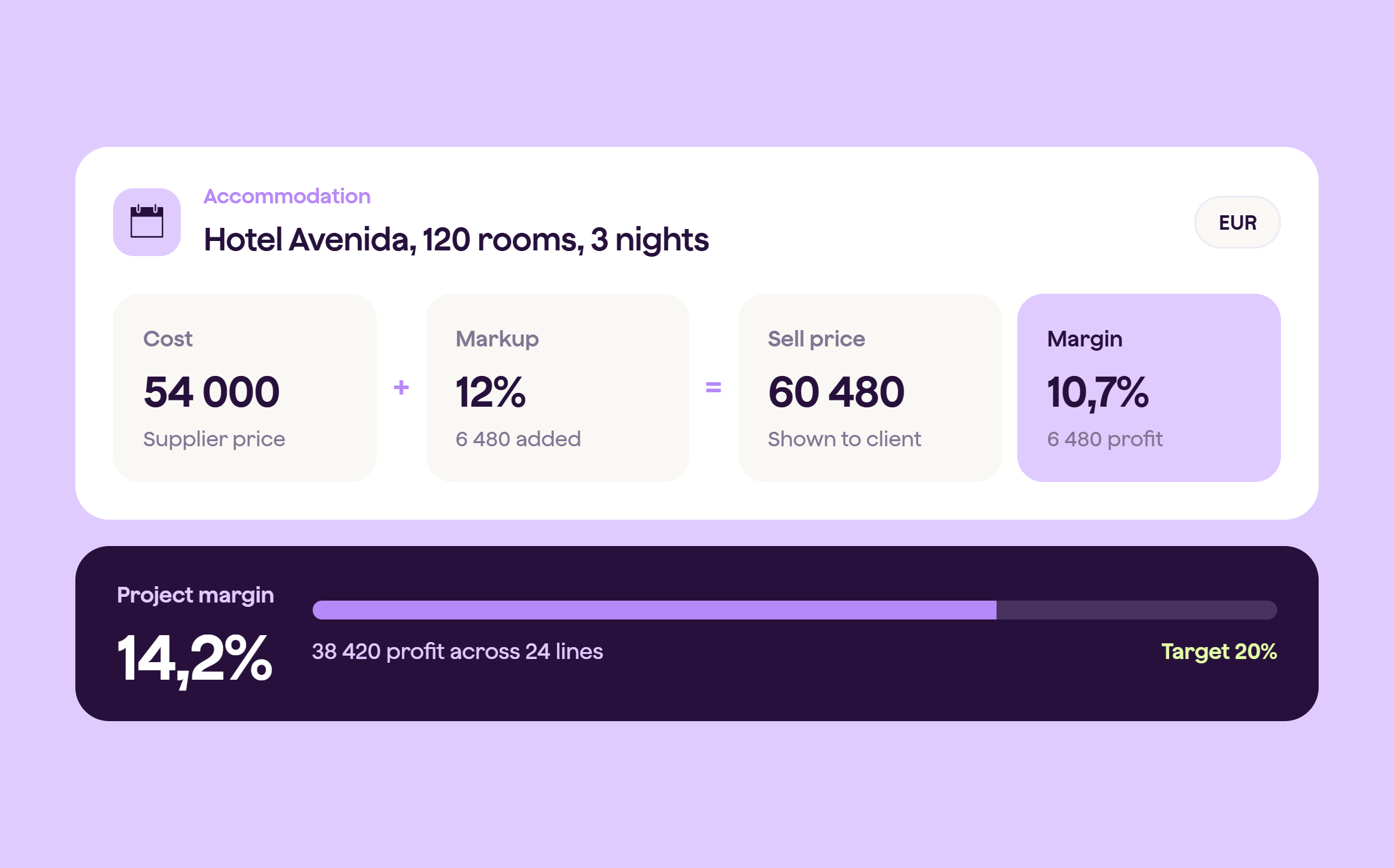
What happens when a cost arrives after the client price is agreed?
This happens on almost every event. An extra AV hire, venue overtime, or a supplier invoice that turns up weeks later.
Carry on with the example. After sign-off, an extra £1,200 of AV cost appears. The client price stays at £30,350. Your costs rise to £24,200, and your margin drops from £7,350 to £6,150, which is about 20% of the client price. With the venue commission, you finish on £6,950.
Then you have a decision to make. If the client asked for the change, add a line and send a change request. If the cost was your own oversight, you absorb it. Either way, record it where you can see it.
Late costs hurt most when nobody sees them until the final invoice goes out. If margin only gets checked at the end, you find out when it is too late to do anything. Our article on preventing scope creep before it eats your margin has a practical process for this.
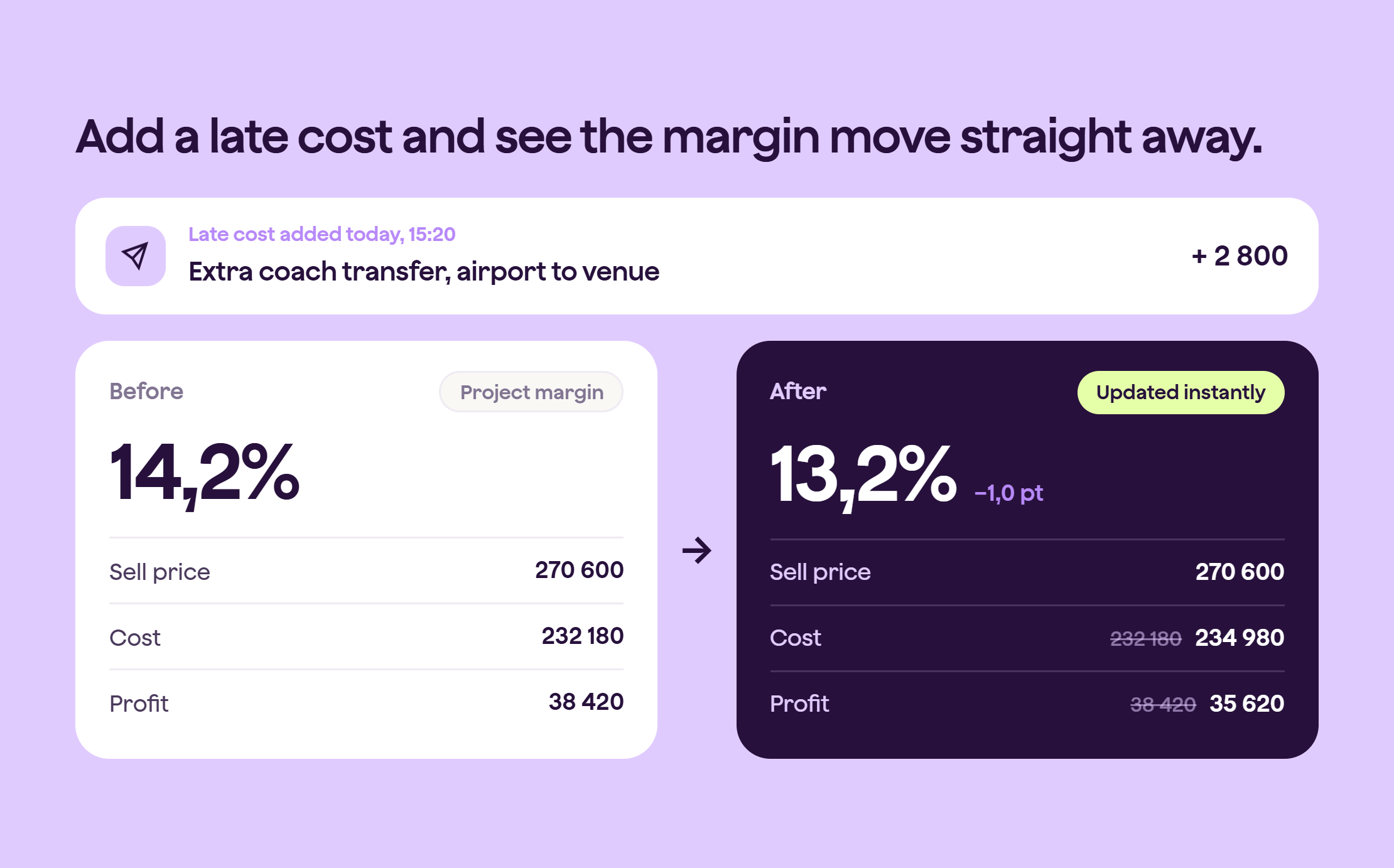
How do you keep a budget flexible without it turning back into a fragile spreadsheet?
Spreadsheets bend because you can type anywhere. They are fragile for the same reason. Formulas break, versions multiply, client and internal tabs drift apart, and margin only gets checked when the event is over.
What you need is flexibility with a safety net. Look for these:
- Edits after confirmation, with a history showing who changed what and when.
- Pricing method line by line, so markup, fee and commission can sit in the same budget.
- Notes on lines, so you can explain a cost to the client.
- Margin that recalculates whenever anything changes.
- A client view that's separate from your internal view.
Our guide on replacing spreadsheets for planning and execution goes deeper on what to move first.
What should your event budget show before you send it?
Run through this list before any quote leaves the building:
-
Cost, sell price and margin on every line.
-
One margin figure for the whole project, in the appropriate currency and as a percentage, labelled as including or excluding commission.
-
The pricing model behind each line: markup, fee, time and materials or commission.
-
Expected commission, and who pays it.
-
Costs still to come, flagged as estimates.
-
The VAT treatment, including TOMS where it applies.
-
A preview of exactly what the client will see.
-
Your terms for changes after sign-off.
-
If you can tick all eight, you can send the quote with confidence. If you can't, that's where margin leaks. Our guide to event budget management covers the wider process.
Where does Qondor fit?
Qondor connects the proposal, budget, time tracking and invoicing in one record. Costs, commissions and supplier invoices update the same budget your proposal came from, so you see margin while the project is still running and not weeks after the invoice goes out.
Want to see it on a real project? Read how event agency software for proposals and budgets works, or book a demo and bring a budget that mixes markup, fees and commission.