Customer review G2
"Saves time and money, makes offers look professional, and keeps improving all the time"
Procim is a well-established project budgeting and financial control tool used by creative and event agencies worldwide. If your team's primary need is deep budget management and cost control, it is a serious platform worth evaluating.
If you need the full M&E agency operating workflow, from digital proposals and attendee management to TMC compliance, sustainability reporting, and programme delivery, Qondor is purpose-built for that.
.png)








Both Procim and Qondor are built for agencies running complex events and projects. Both take financial control seriously. The difference is what each platform covers beyond the budget, and who it's built to serve.
.png)
Procim has been built over 30 years around one core strength: financial control for project-driven creative businesses. Its budgeting engine is formula-free, multi-user, and multi-currency. It handles rate cards, budget revisions, purchase orders, timesheet and expense tracking, and billing schedules with a level of depth that few platforms match.
Procim is used across events, experiential marketing, TV and film production, PR, and advertising. For creative agency groups needing deep financial governance and reconciliation across large, complex projects, it is a genuinely strong platform. The primary audience is creative agency networks, not specifically the meetings and events or TMC market.
Qondor is designed specifically for meetings and events agencies and TMCs. It covers the full commercial and operational lifecycle: digital proposals and client approval, connected budgets, project management, attendee management, supplier coordination, time tracking, invoicing, sustainability and CO₂ reporting, and programme delivery.
The key distinction is that Qondor connects every stage in one platform, purpose-built for how M&E businesses actually operate. For TMCs specifically, it includes TOMS and VAT compliance, rate card and management fee enforcement, and consolidated client billing, capabilities with no equivalent in a generalist creative agency tool.
For meetings and events agencies, the proposal is where the commercial relationship begins. How quickly you respond, how professionally you present, and how easily the client can approve all affect whether you win the project. The tools you use to build and send proposals matter.
Procim generates client estimates directly from the budget, producing a document-format output that reflects the project's cost structure. When the client approves, a Project Acceptance Form (PAF) is created as the internal contractual record.
Qondor proposals are visual, branded, and interactive. Clients receive a digital link, browse the proposal online, select from options, and approve directly within the platform. Once accepted, the proposal converts to a contract automatically, with terms included. The accepted lines feed directly into budgeting and invoicing with no rebuild. For agencies competing on first impressions and speed to confirmation, this is a different commercial lever, and it is connected to everything else in the project from the start.
-1.png)
Managing an event involves more than financial control. Delegates need to register, receive communications, access programmes, and be tracked. Suppliers need to be coordinated. Carbon data needs to be captured. None of this is separate from the commercial workflow, it is the workflow. Having it in the same platform as the budget matters.
Procim's budget engine is formula-free, handles multiple currencies and separate buy/sell exchange rates, supports detailed purchase order approval chains with per-user spending limits, and provides real-time comparison between budgeted and actual costs at line-item level. Its resource scheduling tools are genuinely granular, with a graphical project activity planner that connects resource allocation directly to the budget.
Qondor provides the same financial control anchors; live budget versus actuals, multi-currency, rate cards, margin visibility, time tracking, reconciliation, and billing, and connects them to the full M&E workflow that Procim does not cover: digital proposals with client approval, attendee management, supplier coordination, TOMS and VAT compliance for TMCs, sustainability reporting, and programme delivery.
For M&E agencies and TMCs, the value is not choosing depth over breadth, it is having both in the same platform
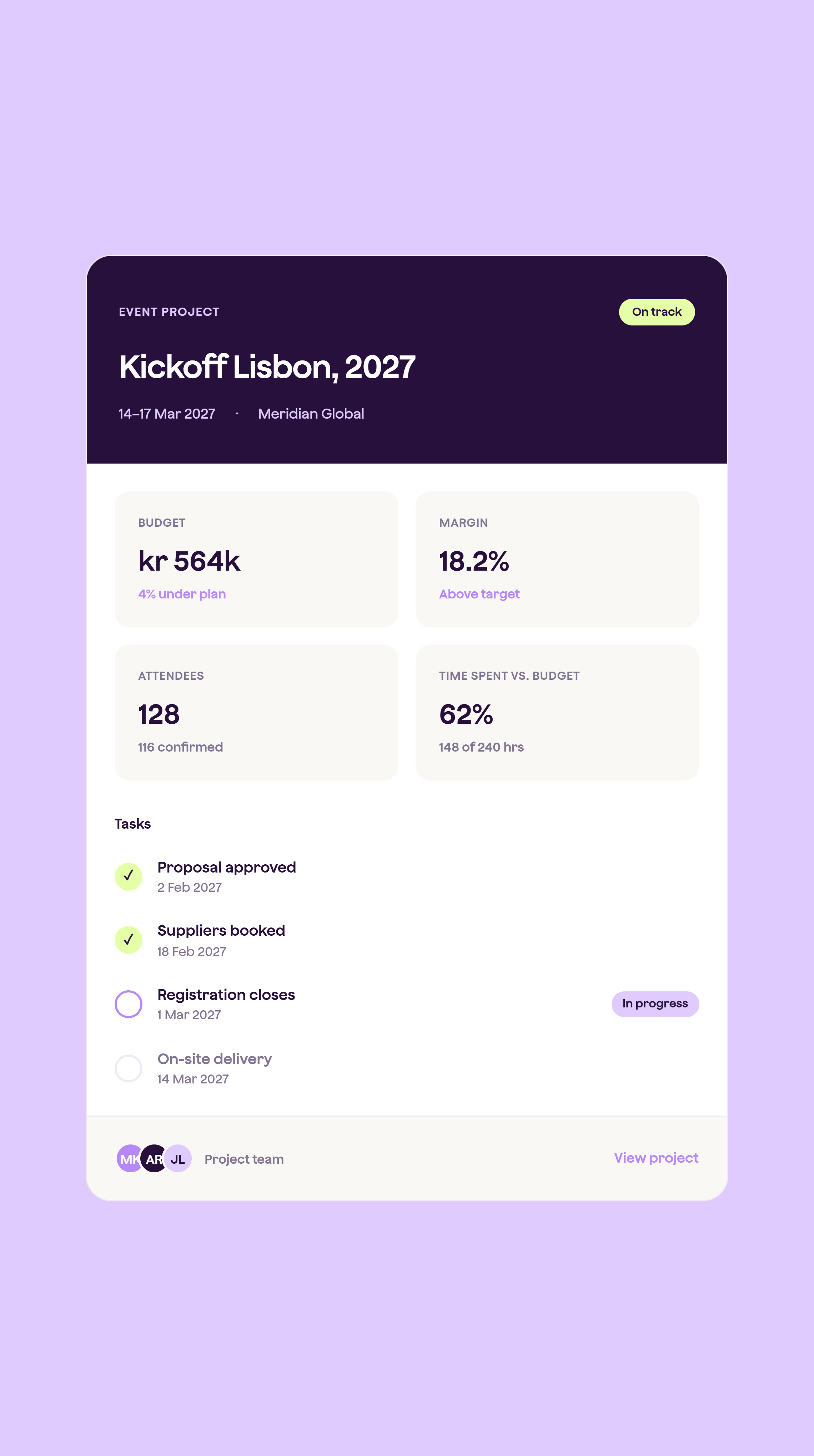
Procim manages the financial and operational project layer extremely well. What it does not cover is the delegate-facing side of event delivery: attendee registration, communications, room allocations, dietary management, mobile programmes, and on-site check-in. Teams using Procim for events typically combine it with a separate registration tool or handle these elements outside the platform, which means data sits in different systems and the client experience is pieced together from multiple sources.
In Qondor, attendee registration, communications, room allocations, dietary requirements, mobile programmes, and delegate management are all part of the same project that holds the budget, proposal, and invoice. Sustainability reporting, including CO₂ data across travel, accommodation, and catering, is also captured within the platform. The delegate experience and the financial workflow are connected, so changes in attendee numbers flow through to costs automatically and nothing lives in a separate system.