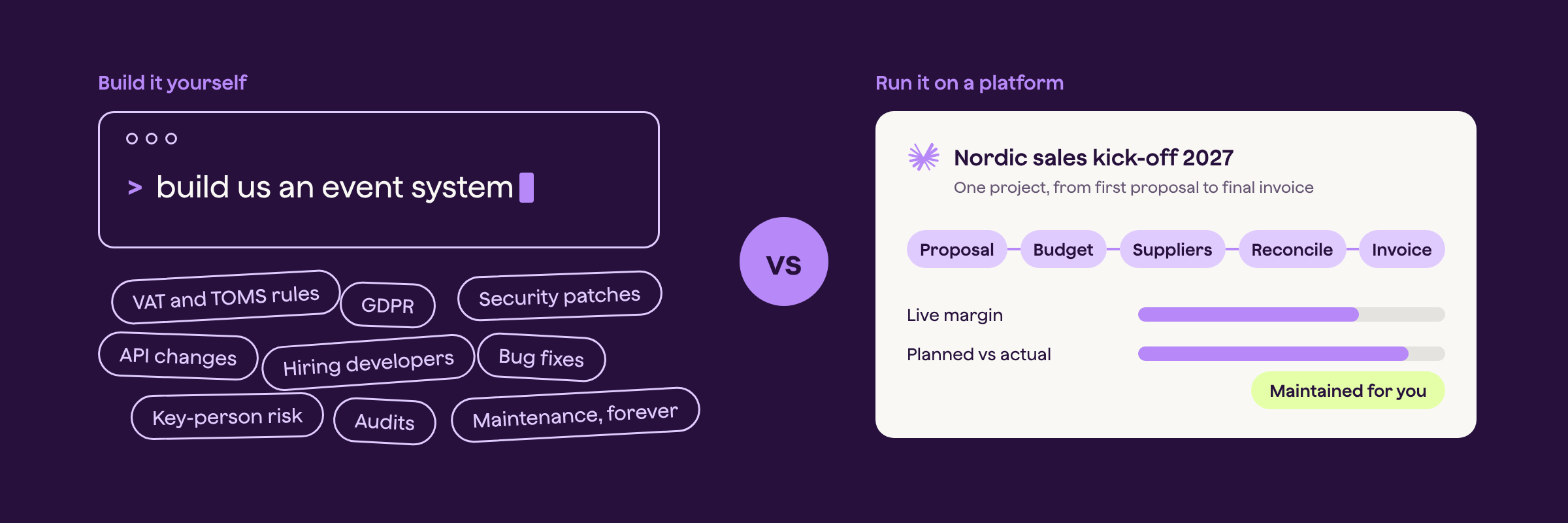
Why are agencies and TMCs looking into building their own system now?
Because AI coding tools have made software look cheap. Tools like Lovable, Replit, Cursor and Claude Code can turn a prompt into a working app in an afternoon. If you have watched a colleague do it, the logic is tempting: why pay for a platform when you could build exactly what you want?
You're not alone in asking. In Retool's 2026 Build vs Buy Report, 35% of respondents said they had already replaced at least one SaaS tool with a custom build, and 78% expected to build more in 2026.
Look closer at what they replaced, though. It was mostly workflow automations and internal admin panels. Small tools, used by a few people, where a bug costs an afternoon.
An M&E business system is a different animal. It holds your margins, your clients' personal data and your VAT position. When it breaks, an invoice goes out wrong or a delegate list leaks. Even a16z's Anish Acharya, whose firm invests heavily in AI, called the idea of vibe coding core business systems "flat wrong".
What would your system actually need to do?
The prototype usually covers a project list and a budget sheet. The business behind the event needs the whole chain from first enquiry to final invoice, connected:
-
Proposals that look professional, reuse content and go out fast.
-
Budgets with planned versus actual costs, updated live as suppliers change.
-
Client rate cards, management fees and commission rules, enforced on every project.
-
Supplier contracts, deposits, payments and reconciliation.
-
Multi-currency pricing and VAT. In the UK, that means the Tour Operators' Margin Scheme (TOMS). In Sweden, the margin scheme works differently again.
-
Time tracking, so billable hours don't leak.
-
Registration, participant lists and attendee communications, all under GDPR.
-
Invoicing, and clean integration with your accounting system (Xero, Visma, Tripletex, Fortnox and so on).
-
Roles, permissions, an audit trail on every budget change, and reporting across every programme.
Each item looks simple on its own. The hard part is that they all depend on each other. Change a supplier cost and the budget, margin, VAT calculation and invoice all have to move with it, correctly, every time.
What are the real benefits of building your own system with AI?
There are some, and they are worth taking seriously
-
Speed to a first version. A prototype that took months can now take days. That's a great way to work out what you need.
-
A perfect fit, at first. You decide every screen and every field.
-
No licence fee. The subscription line disappears from the budget, even if other costs replace it.
-
Good for small, internal tools. A dashboard, an intake form or a one-off automation is a sensible thing to build yourself.
-
The tools keep improving. Research group METR found experienced developers were 19% slower with AI tools in early 2025. In 2026, it said the speed-up is now likely real, though hard to measure.
So building is realistic. The question is what you're building and why, and who looks after it in year three.
How much does it cost to build your own event management system?
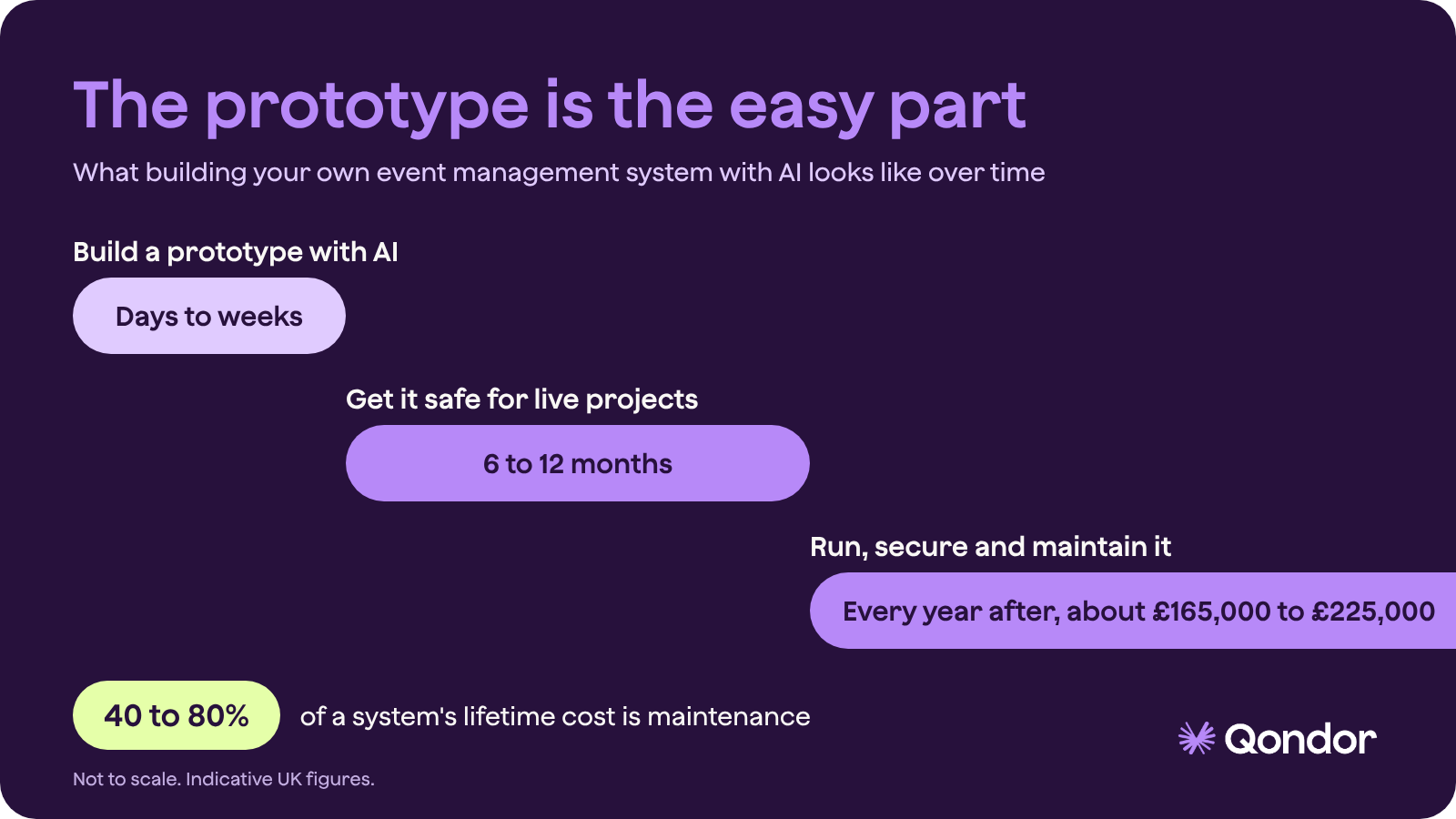
For a core M&E system that a whole team can rely on, plan for roughly £280,000 to £320,000 in the first year and £165,000 to £225,000 every year after that. Those are indicative figures for a UK agency. Your numbers will vary, but the shape rarely does.
AI writes code faster. It doesn't decide what the system should do, check that the VAT is right, or answer the phone when invoicing breaks on a Friday. You still need people.
| Cost line (Indicitative, UK) |
Year 1: build |
Year 2 onwards: run |
|---|---|---|
|
Developers |
2 senior developers, about £180,000 |
1.5 to 2 developers, about £135,000 to £180,000 |
|
Product owner from your own team |
Half their time, about £35,000 |
A day a week, about £15,000 |
|
Design and testing |
About £25,000 |
Included above |
|
Recruitment fees (15 to 20% of salary) |
About £25,000 to £30,000 |
Again whenever someone leaves |
|
Hosting, tools and AI usage |
£10,000 to £20,000 |
£10,000 to £20,000 |
|
Penetration test |
£5,000 to £10,000 |
£5,000 to £10,000 a year |
|
Indicative total |
About £280,000 to £320,000 |
About £165,000 to £225,000 |
How we got there: a senior software engineer in the UK has a median salary of about £75,000 (£95,000 in London). Add 15% employer National Insurance and pension, and each one costs you close to £90,000 a year. In Norway, an average developer earns about NOK 900,000, which comes to roughly NOK 1 million a head with employer's contribution and pension. Penetration test prices are from JUMPSEC's UK guide and recruitment fees from Coburg Banks.
Over three years, that is roughly £610,000 to £770,000 before anyone has asked for a new feature.
How long does it take to build your own event management system?
Expect six to twelve months before the core chain is safe to run live projects on, and longer with accounting integrations and margin-scheme VAT. Hiring alone takes four to eight weeks per developer.
Big software projects also tend to overrun. A McKinsey and Oxford study of 5,400 IT projects found large projects ran 45% over budget and delivered 56% less value than planned. AI has not changed the part where requirements shift halfway through.
What does it cost to maintain afterwards?
More than the build. Software engineering research has long put maintenance at 40 to 80% of a system's lifetime cost, with 60% as a typical figure (Robert Glass, Facts and Fallacies of Software Engineering). Launch day is where the bill starts.
Here is what keeps the team busy after go-live.
Keeping up with the rules.
VAT is the clearest example. Under HMRC's VAT Notice 709/5, TOMS is mandatory for businesses that arrange conferences with delegate accommodation. You need to split venue hire from bundled packages, avoid issuing VAT invoices on margin-scheme supplies, and run a year-end calculation straight after year end.
Sweden's margin scheme (VMB) works almost the other way round for business clients, where VAT must be shown on the invoice. Run programmes in both countries and your system has to handle both. When the rules change, your developers have to notice and update the code.
Get it wrong and HMRC can charge penalties of up to 30% of the tax at stake for careless errors, and up to 100% in the worst cases.
Security and GDPR.
Your system will hold delegate names, contact details, passport data and dietary needs. Under GDPR, a serious failure can mean fines of up to €20 million or 4% of global turnover. The average data breach cost $4.44 million in 2025, according to IBM.
Many corporate clients and TMC buyers now ask suppliers for ISO 27001 or similar evidence before they share data. Certification typically takes six to ten months and, for a smaller company, around £12,000 to £40,000 in year one plus annual audits (Consilien, indicative). That is in addition to the developers.
Everything else that moves.
-
Accounting systems update their APIs, and your integration breaks.
-
Browsers, libraries and hosting platforms need patching.
-
Your team asks for new features, because the business keeps changing.
-
The developer who built it leaves, and takes the knowledge with them.
That last one matters most for a lean agency. One person leaving should never put your invoicing at risk. Yet with a home-built system, it often does.
Stripe's Developer Coefficient study found developers already spend about a third of their week dealing with technical debt. AI-generated code tends to add to that pile faster.